The Handoff Is the System: Operational Software for a Workforce of Agents, Robots, and Humans
I have watched a few layers get built. Networks, then the web on top of them, then APIs on top of that, each layer assuming something about the one beneath it and about who would sit at the top reading the output. A person. The whole stack, all the way up, was built for a human at the terminal. We are now building a layer where that assumption breaks, because the thing at the top is no longer reliably a person. It is a convergence of AI agents, robots, and humans working the same job, and the operating systems these industries run on were not designed for it.
Every field operations platform that exists assumes a human does the work. The dispatch board assumes a person reads it. The work order assumes a technician thumbs through it on a phone. The fleet dashboard assumes a manager watches the map while a licensed driver holds the wheel. HVAC service software, construction management, fleet operations: the entire category is a set of screens designed to help a person do a task or supervise one. The human is not a feature of these systems. The human is the load-bearing assumption. And it is now wrong in a way you cannot patch.
The workforce in these industries is splitting into three kinds of worker: AI agents, robots, and humans. Not “software plus people.” Three distinct classes of thing that can hold a task, complete it, and pass it on. An agent negotiates a scheduling window with another company’s agent over an API. A robot runs the ductwork inspection or the pallet move alongside a human on the same site. A licensed technician performs the refrigerant work or signs the structural inspection because the law requires a person with a credential to do it. On a single job, all three may touch the same task in sequence.
The variation does not stop at the task. It runs all the way up to the company. Some firms will be run almost entirely by agents: a coordination shell with no field staff, dispatching subcontracted robots and humans. Some will be robot-heavy operations with a thin human layer for licensing and exceptions. Some will stay all-human by choice or by trade. Most will be a mix, and the mix will change quarter to quarter. So a system does not just have to route a task across three worker types inside one company. It has to let an agent-run firm transact cleanly with a robot-heavy contractor and a human-only inspection outfit, none of which shares the other’s internal shape. The counterparty is now also of indeterminate composition. That is the real convergence, and why this is a new problem rather than a feature request.
The reflex is to call all of this “human in the loop.” That phrase is the problem. Human-in-the-loop keeps the person at the center of an otherwise automated process, at the approval gate, watching the machine work. The mixed workforce has no center. Sometimes the human is the operator and the agent is support. Sometimes the agent dispatches and the human is a licensed formality invoked once at the end. Sometimes no human touches the task until a client asks a question. The worker type is not fixed. It varies by task, by moment, by regulation, and by which company you are dealing with. A system that hard-codes the human as the hub cannot represent a job where the human shows up only at minute fifty.
The harder truth is that these three workers do not consume information the same way, and no existing interface serves more than one of them. An AI agent does not read a dashboard. It does not squint at a KPI tile or scroll a phone. It wants structured state: an event stream, a queryable object, a schema it can reason over and act on. Give an agent a pixel-perfect dashboard and you have given it nothing. Robots want something different again: a machine-legible task specification, coordinates, tolerances, a telemetry channel back. Humans want the opposite of both. They want context, a map, a judgment prompt, the three facts that matter surfaced above the forty that do not. Build the system for the human and the agents are blind. Build it for the agents and the humans drown. Most operational software today is a human interface with an API bolted on as an afterthought, which is exactly backward for a workforce that is mostly not human.
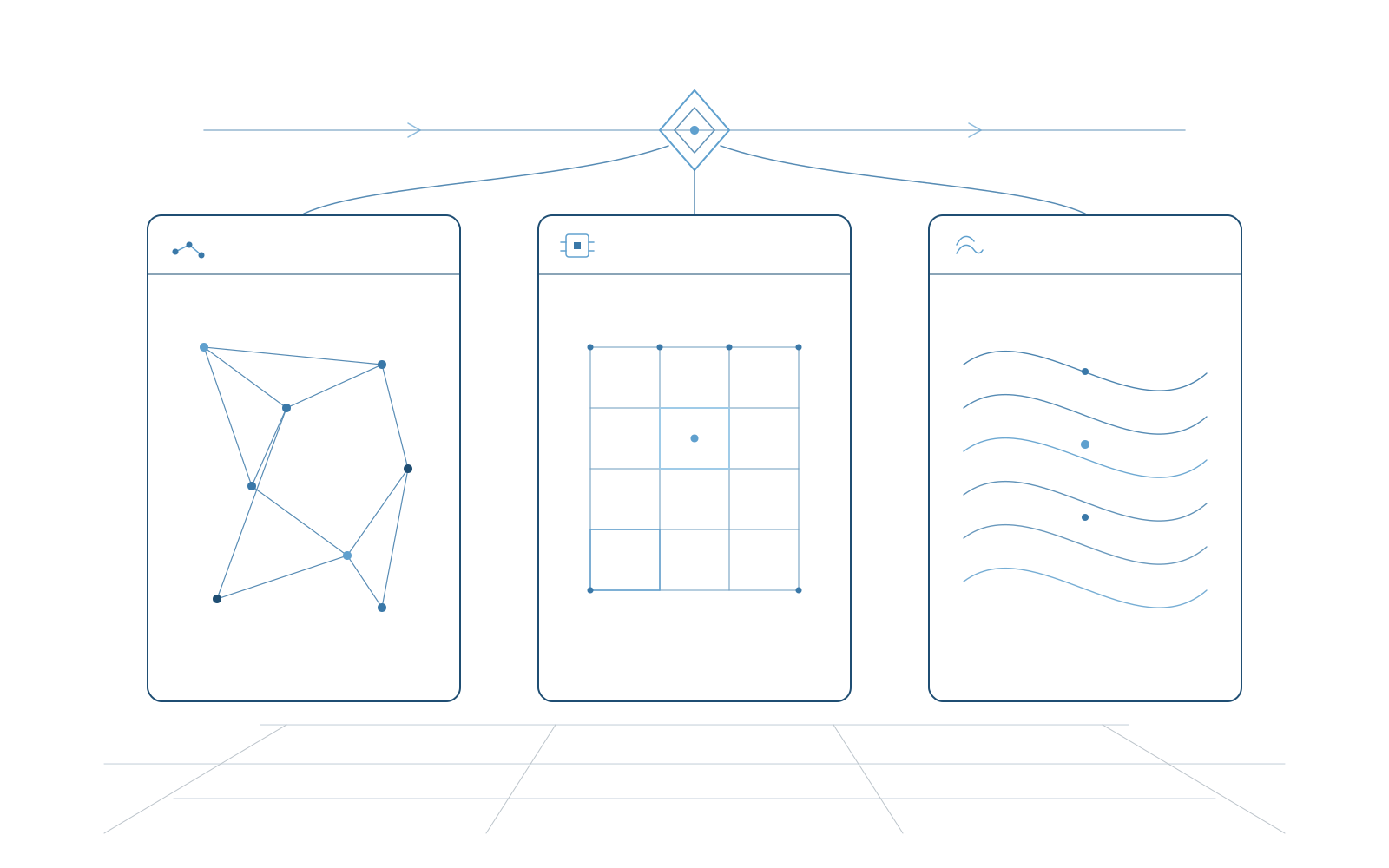
So the design center moves. The task, not the worker, becomes the durable object in the system. A task carries its own state, its history, its requirements, and critically its provenance: who or what has touched it and under what authority. Worker type becomes an assignment, not an assumption. The same task object can be routed to an agent, a robot, or a human, and the system renders it into whatever surface that worker needs. One state layer, three faces. An event stream and API for agents. A protocol and telemetry link for robots. A screen with judgment and context for humans. The information is identical. The rendering is not.
Then comes the part that is genuinely hard, and it is where licensing lives. The handoff. Consider an HVAC job. An agent takes the intake, prices it, and schedules it by talking to the client’s agent. A robot or an instrumented rig runs the diagnostic. But the refrigerant work needs an EPA-certified technician, and the final inspection needs a licensed human to sign, because no regulator accepts a robot’s signature. So the task must move from agent to robot to licensed human, and at each boundary the full state has to travel with it: what was found, what was done, what standard applies, what the human is now legally attesting to. This is not a loop. It is a relay, and the baton is legal accountability. Construction has the same shape at electrical and structural sign-off. Fleet operations has it at DOT inspection and anywhere a commercial license is required. Licensing is not an edge case to bolt on later. It is the structural reason the handoff has to be a first-class object in the system, with authority, provenance, and chain of custody built in.
Communication has to be first-class too, in every direction. Agents talk to other agents. Robots report to agents and to humans. Humans instruct robots, brief agents, and answer clients. And the client, who does not care which kind of worker did the job, needs a coherent account of it from a system where three different worker types each did a piece. A message is no longer a human typing to a human. It is a routed exchange where sender and receiver might each be any of the three, across companies of any composition, and the system has to translate between their native modes without losing meaning.
Here is the honest counterargument. Almost no HVAC shop is staffing robots today. Most two-truck operations do not need an agent orchestration layer, and telling them they do is the overbuilt future that consultants sell and no one uses. Fair. If you run three technicians and a phone, none of this is your problem right now. But platforms are where assumptions get locked in for a decade. The software these industries adopt now will encode, in its data model and its interfaces, an answer to the question “who does the work.” Every system on the market answers “a human,” and bakes that answer so deep that it lives in the shape of the task object itself. When the agents and the robots arrive, and in freight, warehousing, and inspection they are already arriving, those systems will not extend. They will be rebuilt.
I have seen enough layers go in to know that the assumption you make at the bottom is the one you live with for years. The new operating system here is not a better dashboard on the old one. It is a different center of gravity. Model the task, not the worker. Render one state into three surfaces. Make the handoff a real object with authority and provenance inside it. Treat licensing as the thing that keeps humans and machines trading tasks back and forth for a long time.
The company that wins the next decade in the field will not be the one with the best agents or the best robots. It will be the one whose system stops caring which of them shows up.